Project Challenge
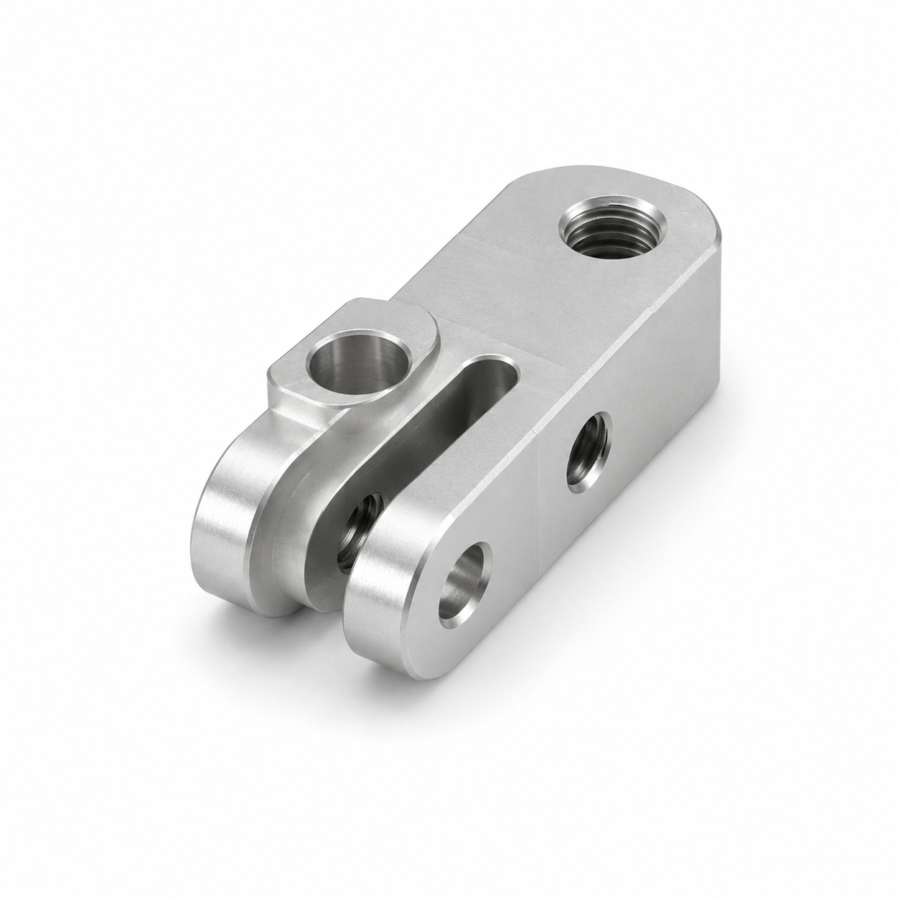
The project required a compact aluminum fork clevis bracket with consistent spacing between the parallel arms, coaxial pin holes, side threaded ports, a long center slot, and clean chamfered edges. The production target was 120 pcs with a +/-0.02mm tolerance, so the machining sequence had to control alignment and repeatability across the full batch.
Our Solution
We rough-machined the center slot first, then used stable datums to finish the fork arms and maintain the required spacing. The pin holes were machined with a controlled setup to support coaxial alignment, while the side ports were tapped after the main milling operations. Final edge chamfering and matte finishing completed the part before inspection.
Quality Check
Inspection covered fork spacing, pin-hole diameter and alignment, threaded-port quality, slot width, edge chamfers, and overall surface consistency. The parts were reviewed against the drawing requirements and checked for visible machining marks or damage before packing. This process helped keep the 120-piece batch consistent and ready for assembly.
Project Overview
This project focused on producing 120 aluminum fork clevis brackets for an assembly requiring reliable pin connection and repeatable fit. Each part combines parallel fork arms, coaxial pin holes, side threaded ports, a long center slot, and chamfered edges in a compact geometry. The +/-0.02mm tolerance made the relationship between the fork gap, hole position, and slot especially important. The matte finish also needed to remain visually consistent across the complete batch.
Manufacturing Approach
Manufacturing began by rough-milling the center slot while leaving sufficient material for the finishing operations. Stable datums were then used to finish the parallel fork arms and maintain consistent spacing. The pin holes were machined in a controlled sequence to support coaxial alignment, followed by tapping the side threaded ports after the critical dimensions had been checked. Final operations included edge chamfering, deburring, cleaning, and preparation of the matte surface finish.
Quality Assurance
Inspection focused on the functional relationship between the features rather than checking each dimension in isolation. Fork spacing, slot width, pin-hole diameter, and hole alignment were reviewed against the drawing requirements. The threaded ports were checked for clean engagement, while chamfers and edges were examined for burrs or machining damage. Surface appearance and matte-finish consistency were also reviewed before the 120-piece batch was cleaned, protected, and prepared for packing.